Skip to content
SNTURCO

Textile knowledge

The yarn guide.

Short, accurate answers to the questions buyers ask most, with simple examples.

01

Natural and synthetic fibres

Natural fibres come from plants (cotton, linen, hemp) or animals (wool, silk). Synthetic fibres are made from polymers produced by the chemical industry, such as polyester, polyamide, acrylic, polypropylene and elastane. Natural fibres are usually more absorbent; synthetics are usually stronger, lighter and quicker to dry.

Example:A 60/40 cotton/polyester T-shirt combines the comfort of cotton with the shape retention of polyester.
02

Regenerated fibres

Regenerated fibres are made from natural raw material, usually cellulose from wood or bamboo, that is dissolved and formed again into a fibre. They sit between natural and synthetic: the raw material is natural, the fibre is made in a factory. Viscose, modal and lyocell are the best-known examples.

Example:Most "bamboo" yarn is bamboo viscose: bamboo cellulose regenerated into a soft, lustrous fibre.

Related yarns:Viscose →Bamboo →

03

How is yarn made?

Spinning turns loose fibres into a continuous yarn. For cotton, bales are opened and cleaned, then carded so that the fibres lie in a web and become a sliver. Combing removes short fibres for finer yarns. Drawing makes the sliver even, and spinning draws it thinner and inserts twist. Finally the yarn is wound onto cones.

Example:Combed yarn skips none of these steps and adds combing; carded yarn skips combing and is fuller and less even.

Related yarns:Cotton →

04

What is ring-spun yarn?

In ring spinning, the drafted fibre strand is twisted by a traveller running around a ring while the yarn winds onto a bobbin. Fibres lie well aligned, so ring yarns are strong, smooth and soft. Compact spinning is a ring method that condenses the fibres before twisting, giving even less hairiness.

Example:Premium T-shirts are often knitted from combed or compact ring-spun cotton.

Related yarns:Cotton →

05

What is open-end yarn?

Open-end (rotor) spinning separates the sliver into individual fibres and collects them in a fast-turning rotor, where they are twisted into yarn. It is very productive and suits coarser counts. Open-end yarns are more even but less strong and slightly harsher than ring yarns.

Example:Denim, towels and workwear often use open-end cotton yarn.

Related yarns:Cotton →

06

Filament and staple fibre

A filament is a continuous fibre of practically unlimited length: silk, and synthetics as they come from the spinneret. Staple fibres are short, from a few millimetres to several centimetres, like cotton and wool, or synthetics cut to length. Staple fibres must be twisted together to make a yarn; filaments can be used with little or no twist.

Example:Polyester filament gives smooth, shiny linings; polyester staple spun with cotton gives a soft, matt yarn.

07

What is twist?

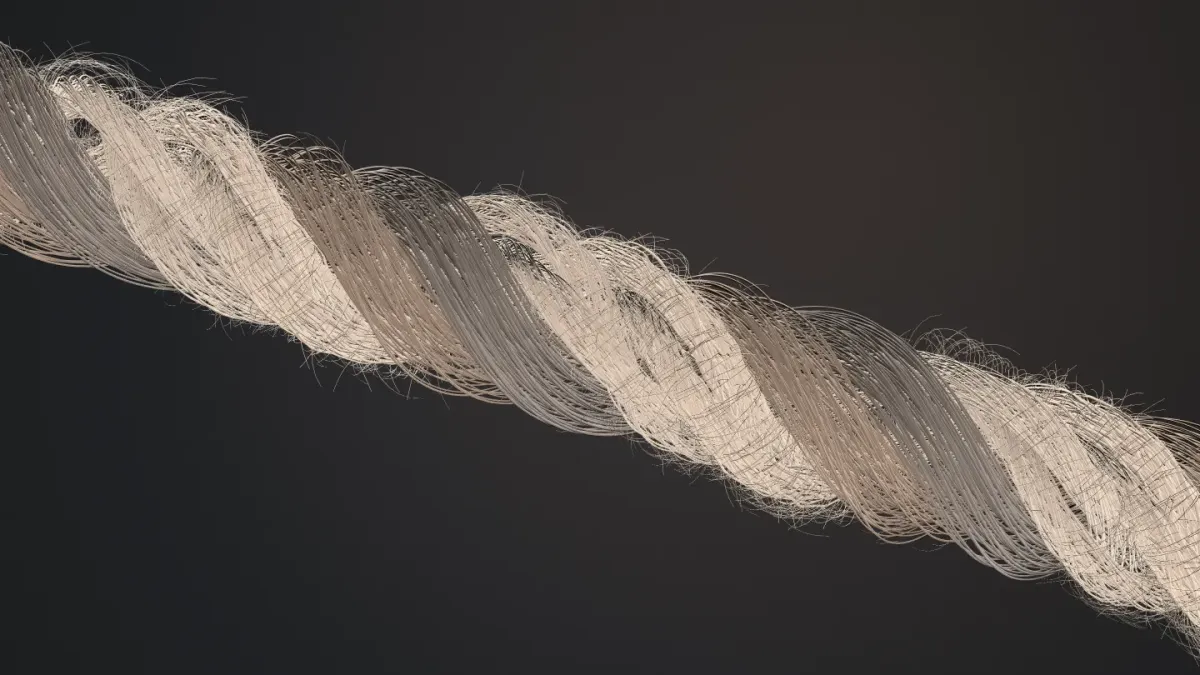
Twist is the number of turns given to a yarn per unit length, for example turns per metre. It holds staple fibres together and changes the yarn’s character: more twist makes a yarn stronger and harder, less twist makes it softer and bulkier. The direction is S or Z, after the slope of the fibres.

Example:Two Z-twisted singles plied together with S twist make a balanced two-ply yarn.

Related yarns:Cotton →Wool →

08

What is yarn count?

Yarn count expresses how fine or coarse a yarn is, as a relation between length and weight. Indirect systems (Ne, Nm) give length per weight: the higher the number, the finer the yarn. Direct systems (tex, dtex, denier) give weight per length: the higher the number, the coarser the yarn.

Example:Ne 40 is finer than Ne 20; 150 denier is coarser than 75 denier.

09

Ne and Nm

Ne (English cotton count) is the number of 840-yard hanks in one pound. Nm (metric count) is the number of kilometres in one kilogram. They convert with a fixed factor: Nm ≈ 1.693 × Ne. In the direct system, tex = 1000 ÷ Nm.

Example:Ne 30 ≈ Nm 50.8 ≈ 19.7 tex.

Related yarns:Cotton →Wool →

10

How is yarn quality evaluated?

Laboratories test a yarn for count and count variation, evenness (mass variation along the yarn), imperfections (thin places, thick places and neps), hairiness, strength and elongation, and twist. Raw material quality, spinning method and machine settings all show up in these results.

Example:Ask for a test report with the offer and compare it with the yarn you use today.

11

What to consider when choosing yarn

Start from the end product: knitting or weaving, fabric weight and the hand you want. Then decide the fibre or blend, count, spinning method (ring, compact, open-end), twist, and any certificates the buyer requires. Quantity, colour (raw white, dyed or melange) and delivery time complete the request.

Example:Single jersey T-shirt: Ne 30/1 combed compact cotton, raw white, for circular knitting.

12

Where yarns are used

Apparel is the largest use: knits such as T-shirts and knitwear, and wovens such as shirts and denim. Home textiles include towels, bed linen, curtains and upholstery. Technical textiles use yarns for strength, filtration, safety or medical purposes.

Example:The same cotton can become a towel (open-end, low twist) or a fine shirt (combed, compact, higher twist).

Tell us what yarn you need.

Send the yarn type, count, quantity and delivery destination. We reply with options and clear terms.